Aug 25,2026
When a food manufacturer evaluates dehydrated bell pepper flakes for a new soup mix or seasoning blend, the conversation rarely starts with color or aroma. It starts with specifications: moisture content, particle size distribution, rehydration ratio, and microbial limits. These numbers determine whether the ingredient will behave consistently across production batches and whether the finished product will match the label claim. For procurement professionals and product developers, understanding these parameters is the first step toward a reliable supply relationship.
This guide covers how dehydrated bell pepper flakes are produced, which quality benchmarks matter in a commercial setting, and how to evaluate a manufacturer before committing to a volume order.
How Dehydrated Bell Pepper Flakes Are Made
Dehydrated bell pepper flakes begin as fresh peppers that are washed, cored, and deseeded, then cut into flat pieces of a defined size. Most industrial lines briefly blanch or steam-treat the cut pieces to inactivate enzymes that could cause browning or off-flavors during drying and storage. The peppers are then dried in forced-air dehydrators at carefully controlled temperatures, typically in the range of 60 to 80 degrees Celsius depending on the equipment and the desired output. Drying continues until the moisture content falls below the level at which bacteria, molds, and yeasts can survive.
Raw material sourcing is one of the largest variables in pepper flake quality. Peppers that travel long distances before processing are more likely to soften, bruise, or lose color. Processing close to the growing area reduces that risk. Jiahe Foods, for example, operates a factory in Inner Mongolia that is described as the largest green pepper, red pepper, and tomato production base in northwest China. The facility was built so that peppers can be harvested, transported, and processed with minimal delay, which supports brighter color and better structure in the finished flakes. A closer look at the general production steps is available in our article on how dehydrated vegetables are made .
After drying, the flakes pass through sieves that separate them into size classes. Sorting and inspection remove stems, seeds, calyx fragments, and discolored pieces, while a metal detector checks the final stream before packing. The result is a clean, uniform ingredient that rehydrates predictably in hot water or during cooking.
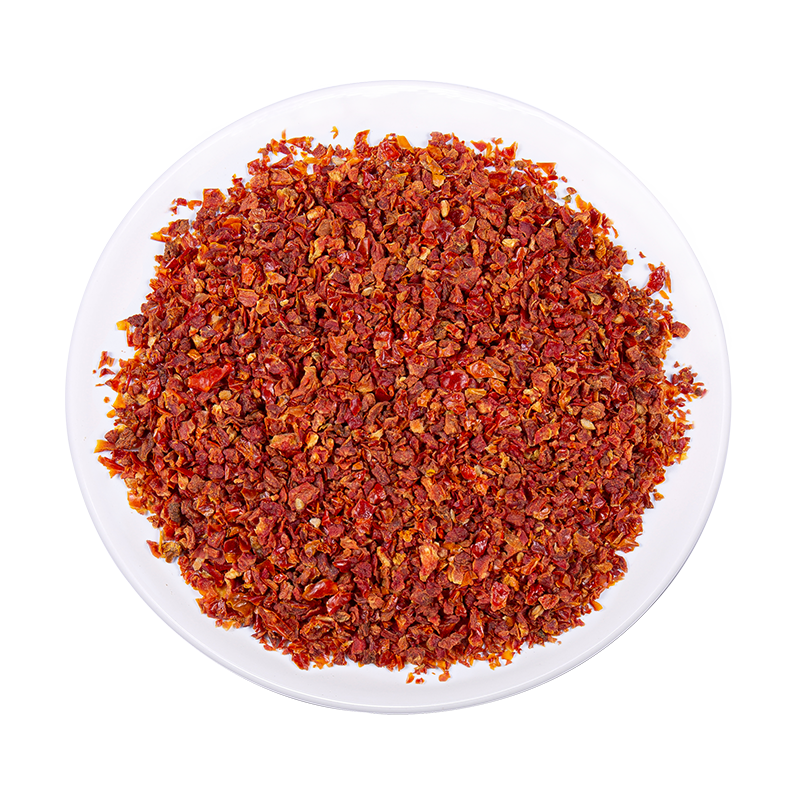
Buyers who build products around a strong red visual often choose dehydrated red pepper flakes made from fully mature peppers. Pigment levels at harvest determine how bright the flake remains after drying, so growing conditions and harvest timing are as important as the dryer settings.
 Dehydrated Red Bell Pepper Manufacturers, Dried Red Pepper Suppliers Xinghua Jiahe Foods Co., Ltd is China dehydrated red pepper manufacturers and dried red pepper suppliers, our factory wholesale dehydrate... View Product →
 Quality Benchmarks for Industrial Buyers
Food manufacturers judge dehydrated bell pepper flakes against a defined set of parameters before approving a supplier. The most common are moisture content, color consistency, particle size, rehydration behavior, and the absence of defects. A manufacturer with a mature quality system can document each of these for every lot, which reduces the approval workload on the buyer's side.
| Parameter | Typical Specification | Why It Matters |
|---|---|---|
| Moisture content | 8% or lower, often 5-6% | Controls microbial stability and shelf life |
| Particle size | 3-6 mm flakes or custom sieve cuts | Ensures uniform rehydration and appearance |
| Rehydration ratio | Approximately 1:4 to 1:6 in hot water | Determines yield and texture in the final dish |
| Color consistency | Uniform red or green per lot | Keeps the finished product visually stable |
| Defects | No stems, seeds, or foreign material | Protects food safety and finished product quality |
Moisture content is the first checkpoint. Most industrial specifications require flakes to be dried to 8 percent moisture or lower, and many buyers set a stricter limit of 5 to 6 percent to allow a safety margin for storage and transport. Lower moisture reduces the risk of enzymatic browning and prevents caking or odor pickup from the packaging environment.
Rehydration testing is another standard step. A typical dehydrated bell pepper flake absorbs roughly four to six times its weight in water, but the exact ratio depends on the cut, the drying method, and water temperature. Manufacturers run this test in hot water for a set number of minutes and compare texture and color against a reference sample, which is the closest approximation of how the flake will behave in a soup or sauce.
Certification adds another layer of confidence. A supplier with BRC certification has passed a third-party audit of its food safety management system, covering HACCP, traceability, pest control, and other core areas. Jiahe Foods has held BRC certification since 2010 and upgraded to A in 2024, so buyers can request the latest certificate and confirm that the audit scope covers the specific product line they intend to source.
Where Food Manufacturers Use Bell Pepper Flakes
Dehydrated bell pepper flakes are among the more versatile ingredients in a food manufacturer's pantry. They rehydrate in roughly five to ten minutes in hot water, making them easy to incorporate into instant noodle seasonings, soup mixes, pasta sauces, pizza toppings, and ready meals. In dry seasoning blends, the flakes add visible vegetable content and a mild, sweet capsicum flavor without introducing moisture or requiring cold-chain storage.
Color is as important as flavor in many of these applications. Dehydrated green pepper flakes hold their color well and are frequently specified for herb-and-vegetable blends, chutneys, and dishes where a fresh green accent is expected. Red flakes are preferred in tomato-based sauces and dry rubs because they blend visually with red ingredients while still providing a distinct flake identity. When the formulation calls for heat, dehydrated jalapeno flakes offer a controlled spicy kick without affecting the water activity of the mix.
Dehydrated/Dried Green Bell Peppers Manufacturers, Suppliers, Factory Xinghua Jiahe Foods Co., Ltd is China dehydrated green bell pepper manufacturers and custom dried green pepper suppliers, our factory who... View Product → Flakes can also be milled into powder. A manufacturer that buys bell pepper flakes can grind them in-house to produce coarse or fine powders for spice blends, marinade bases, or natural color systems. This flexibility means the same raw material can serve multiple product lines, which simplifies inventory management and reduces the number of SKUs a manufacturer needs to hold.
Sourcing Considerations for Volume Orders
Once a sample is approved, the next question is whether the supplier can reproduce that standard at commercial scale over multiple shipments. That requires looking at raw material supply, processing capacity, and operational discipline.
- Raw material security: Bell peppers are seasonal, so a processor with dedicated growing areas or long-term contracts with local farms can offer more stable supply and consistent quality than one that buys on the open market.
- Processing capacity: Factories with multi-thousand-ton annual capacity can absorb volume fluctuations and shorten lead times. Jiahe Foods operates two plants with a combined annual capacity of roughly 6,000 to 8,000 tons, and a third expansion is underway at its Xinghua base.
- Customization: Flake size, color sorting, and packaging formats can all be adjusted, but only if the production line is flexible enough to handle custom cuts without cross-contamination.
- Documentation: Traceability records, pesticide residue reports, and lot-by-lot certificates give the buyer's quality team the information it needs to approve consistent supply.
These factors become critical when a product is sold through retail. A subtle change in flake color, size, or rehydration behavior can trigger consumer complaints, reformulation work, or delisting. Working with a manufacturer that maintains a broad pepper product line, including sweet bell pepper options and dehydrated jalapeno flakes for heat profiles, also makes it easier to consolidate orders and keep the same raw material source across multiple SKUs.
Wholesale Dried/Dehydrated Jalapeno Manufacturers, Suppliers - Xinghua Jiahe Foo Xinghua Jiahe Foods Co., Ltd is China wholesale Dehydrated Jalapeno suppliers and manufacturers, as exporter&importer, our factory custom... View Product → How to Evaluate a Dehydrated Bell Pepper Flake Supplier
Start with the certificate. Ask for the latest BRC certificate and verify that its scope covers the products you are buying. Then examine the manufacturing footprint. A manufacturer that processes peppers close to the growing region has a structural advantage in raw material quality, while a supplier with multiple factories can offer flexibility if one site is affected by weather or seasonal issues.
Run your own verification tests rather than relying on the supplier's data sheet alone. Rehydrate samples in the same conditions your factory uses, measure particle size distribution with your own sieves, and compare lots from at least two different production dates. Batch-to-batch consistency is often the deciding factor between a supplier that is easy to work with and one that creates constant rework.
Finally, assess the technical relationship. A good supplier will ask how the flakes are used in your formulation and propose adjustments to drying curves, sieve cuts, or packaging that improve performance in your specific application. For food companies that buy dehydrated vegetables on a regular basis, dealing directly with a certified manufacturer such as Jiahe Foods can reduce lead times, simplify documentation, and give product development teams more room to fine-tune formulations.